The Price of Creation: When Art Outsmarts Money

The biggest religion in the world? Business. The deadliest drug? Money. Don’t believe me?
Take Danish artist Jens Haaning who, in 2021, sold two entirely blank canvases to Kunsten Museum of Modern Art for $84,000 titled Take the Money and Run. The piece is a modern critique on the disproportionate institutionalization of poor wages for the exhibit Work it Out in, an exploration into people’s relationship with work.
It’d be fools gold to conclude Haaning’s stunt is purely representative of money’s correlation to the value of things and consequently excessive and frivolous spending by blind affluence—a beating-of-the-dead-horse kind of message. Haaning told P1 Morgen that "I encourage other people who have just as miserable working conditions as me to do the same . . . if they are sitting on some shit job and not getting money and are actually being asked to give money to go to work . . . they should take the money and run.”
On the surface Haaning speaks of determining one's fate; that he who sets himself the task of singling out the thread of order from the tapestry will have, by decision alone, taken charge of his world. However, upon further inspection, I adamantly find that the value in art isn’t so much determined by the price of its tag but rather the transformative messages depicted onto the interpreter by the creator so as to stimulate physical, emotional, educational, and spiritual awakenings from within.
In what was supposed to be a 1.3£ million auction for Girl with Balloon at Sotheby’s in 2018 turned all hell loose after the hammer dropped and the canvas lowered itself through a shredder built into the bottom of the frame. After it was halfway destroyed it was sold again at Sotheby’s in 2021 for £18,582,000. Some call it an elaborate prank; others call it “instant art world history”; I call it a stroke of modern genius in a room of avaricious moguls: exactly what this world needs.
Despite Bansky’s act, the art world—fueled by the same insatiable desire for wealth it so often critiques—turned the remnants into another commodity, one stripped of its revolutionary power and shaped into another trophy for the elite. What the stunt exposed was not the folly of art's commercialization, but rather the blindness with which those who control the purse strings approach its deeper meanings. The idea of art as an agent for awakening change is lost on those who view it only as a status symbol or a means of enriching themselves further. This is where Haaning’s message echoes: that art, much like the labor of the underpaid, is often manipulated and exploited by the very systems it seeks to critique.
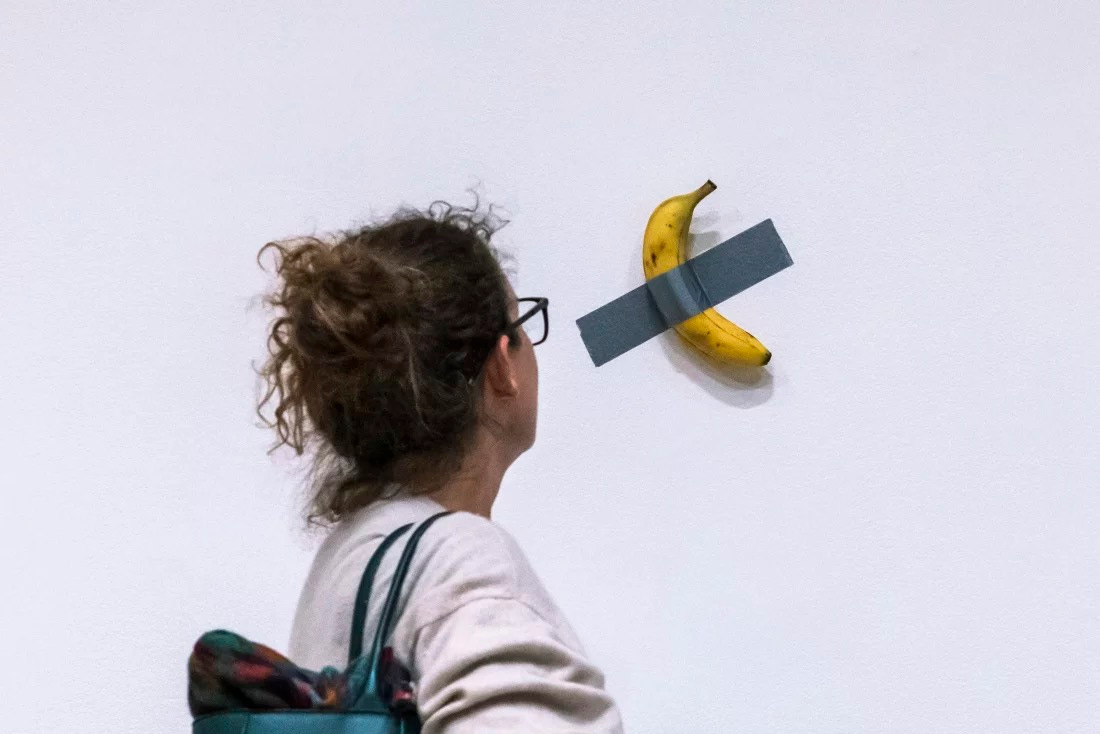
Comedian, contrived in New York by Italian artist Maurizio Cattelan in 2019, sold for $5.2 million on Nov. 11, 2024. It’s quite literally a banana duct taped to a wall. At one point another artist took the banana off the wall and ate it. Justin Sun, the founder of cryptocurrency platform TRON paid 40 times the price at the Sotheby's auction. Two handlers held the banana at both sides with white gloves. In a statement, Sun said the piece "represents a cultural phenomenon that bridges the worlds of art, memes, and the cryptocurrency community."
This so-called real world of men and money and power hums merrily along in a pool of conceitedness and superciliousness and the worship of self. These acts of defiance can only ever serve as reminders of a system that refuses to let go of its hold on value. Perhaps a renaissance is what we need—not of art, but of the values we place on it.